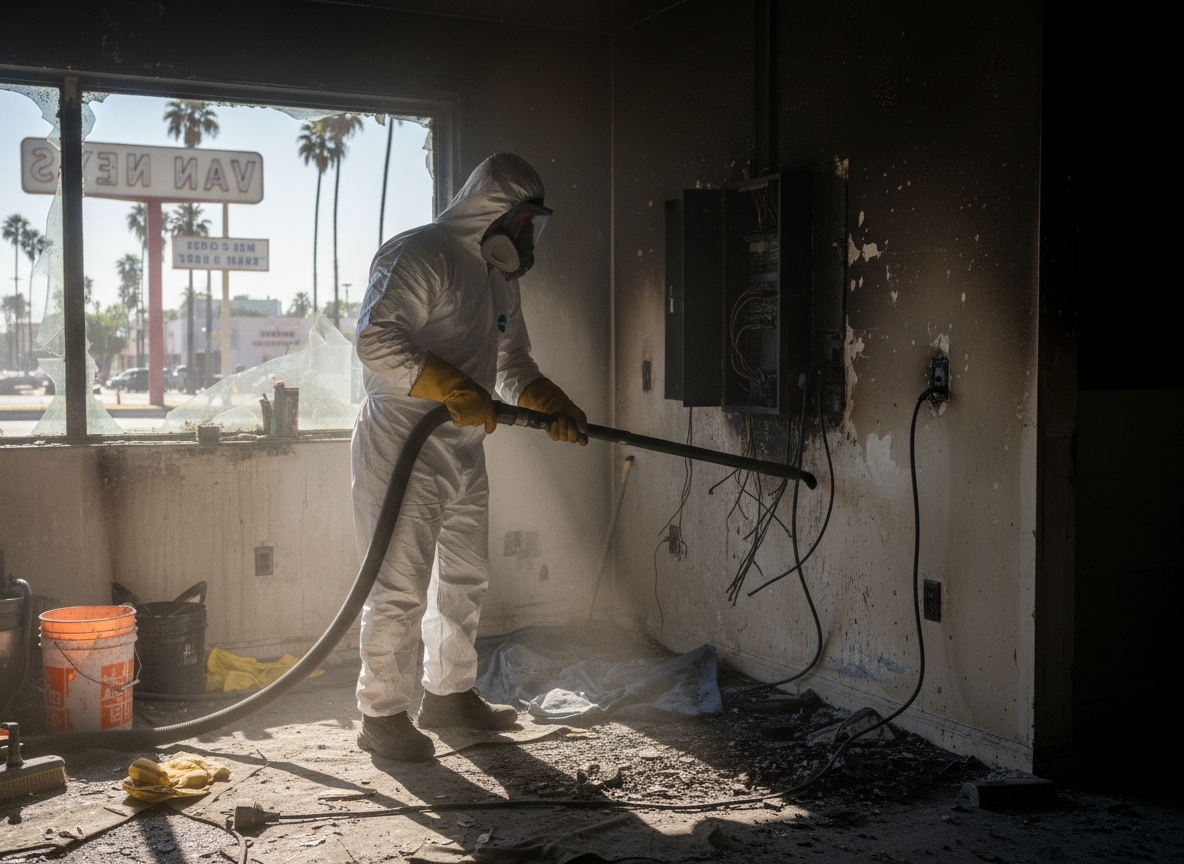
Electrical fires in Van Nuys often start in outdated circuits common to 1950s-1970s homes near Van Nuys City Hall and along Woodman Avenue. Hot dry summers accelerate insulation breakdown, allowing arcs to travel farther through walls before detection. Cleanup requires isolating live circuits first, then removing carbonized residue that conducts electricity and can reignite. Technicians map affected runs with thermal imaging because standard visual checks miss damage behind plaster in these older builds.
Soot from electrical fires bonds to HVAC ducts and porous materials faster in Mediterranean climate conditions, spreading through single-story ranch homes typical in Lake Balboa. Neutralizing acidic residues prevents ongoing corrosion on copper wiring and metal fixtures. Crews use HEPA vacuums and specialized sponges rather than water-based methods that could drive contaminants deeper into stucco exteriors or slab foundations common here. Adjacent Sherman Oaks and North Hollywood properties share similar housing stock, so cross-contamination risks rise when shared alleys or utility lines are involved.
Code compliance in Los Angeles County means any repaired electrical work after fire must meet current standards even if the original installation predates them. Homeowners near Van Nuys Airport frequently discover that insurance adjusters require documentation of removed charred joists to avoid future claims. Skipping proper neutralization leaves odors that return during the next Santa Ana wind event when low humidity pulls trapped particles back into living spaces.
Post-cleanup verification includes continuity testing on remaining circuits and air sampling for particulates before drywall replacement. This step catches intermittent faults that surface only after load is restored, a frequent issue in Van Nuys two-story additions built over original single-family footprints.
Technician insight
In Van Nuys, the thing that catches most people out with Electrical fire cleanup is how knob-and-tube wiring in 1950s homes near Van Nuys City Hall lets charring travel along joists during our hot dry summers, so what looks like a small outlet fire often requires opening twice the wall area once you start pulling insulation.
Outlet fire in Downtown Van Nuys duplex
A tenant reported sparks from a bedroom outlet during a summer heat wave. Inspection revealed charred knob-and-tube runs extending into the shared attic. Crews isolated the panel, removed carbonized sections, neutralized residues, and tested the remaining circuits before drywall replacement.
How it works
- 1
Site Assessment
Technicians inspect all electrical panels, outlets, and runs for charring while documenting soot migration paths through the structure.
- 2
Power Isolation
Circuits are de-energized and verified with non-contact testers before any cleaning begins to prevent secondary faults.
- 3
Residue Removal
Dry and chemical sponges lift carbon deposits from surfaces; HEPA extraction follows to capture airborne particles in ducts and attics.
- 4
Neutralization and Testing
pH-neutralizing agents treat affected areas, followed by continuity and insulation-resistance tests on remaining wiring.
- 5
Final Clearance
Air quality sampling and visual inspection confirm the space is ready for reconstruction or occupancy.
Pricing
Upfront quotes provided after on-site inspection; final cost depends on number of circuits involved and extent of hidden charring behind walls.