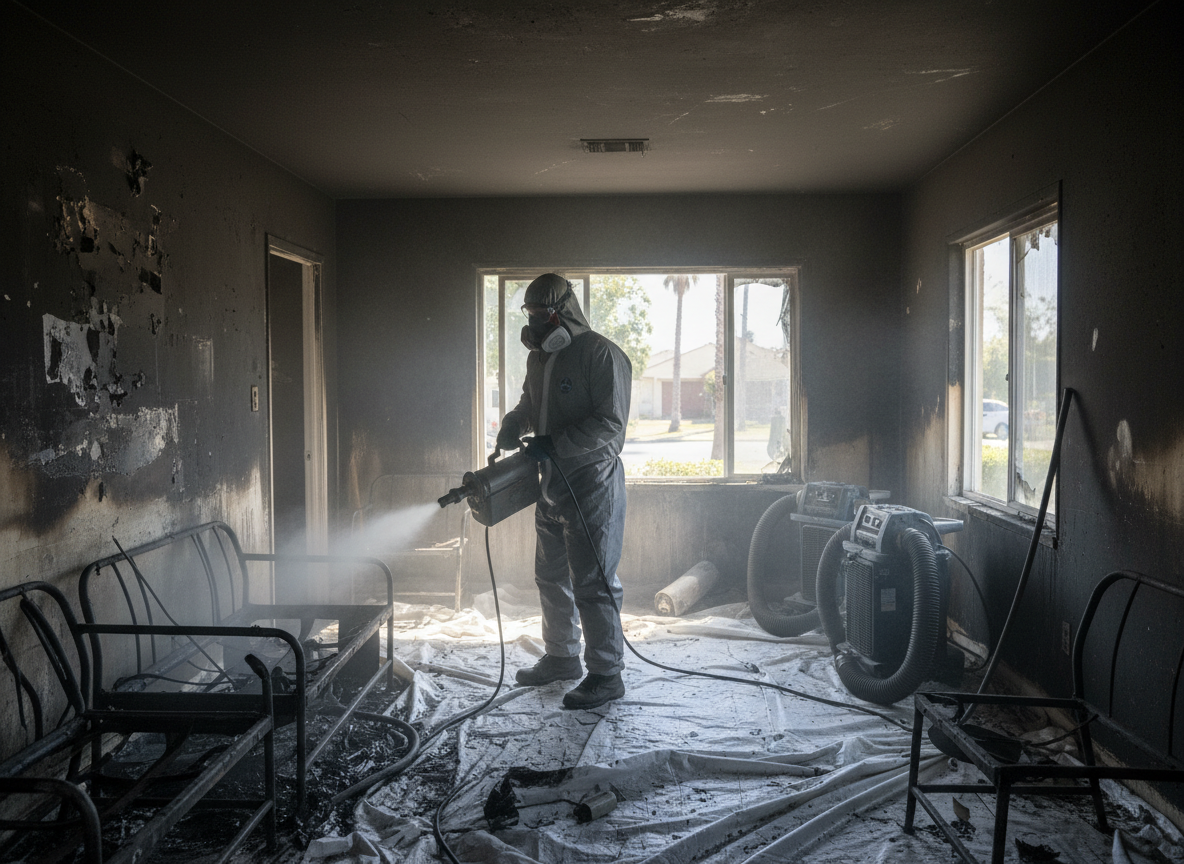
Van Nuys homes built in the 1940s through 1960s often feature plaster walls, lath, and forced-air systems that pull smoke deep into cavities during fires. In the Mediterranean climate with hot dry summers, these odors linger because low humidity prevents natural dissipation and instead bakes residues into wood framing and insulation. Effective removal requires identifying every migration path from attics to crawl spaces, especially in neighborhoods like Downtown Van Nuys and areas adjacent to Sherman Oaks where many single-story ranch houses share similar construction.
Thermal fogging combined with hydroxyl generators neutralizes odor molecules on porous surfaces without leaving chemical residues that could affect indoor air in tightly sealed Los Angeles County homes. Technicians must also address HVAC ducts that run through attics, as smoke travels through these pathways and re-contaminates living spaces after initial cleaning. Skipping duct cleaning or failing to treat subflooring near Lake Balboa properties frequently leads to recurring smells weeks later when temperatures spike.
Edge cases include properties near Van Nuys Airport where aviation fuel residues can mix with smoke, creating stubborn hydrocarbon odors that demand specialized solvents. Homeowners should never attempt DIY ozone treatments in occupied spaces, as improper concentrations damage electronics and fail to reach wall voids common in North Hollywood-adjacent buildings. Professional assessment always includes moisture mapping to rule out hidden water damage from suppression efforts that can reactivate odors.
Technician insight
In Van Nuys, the thing that catches most people out with Odor removal after fire is how 1950s plaster-and-lath homes around Van Nuys City Hall and Lake Balboa Park hold smoke in wall cavities during our hot dry summers; skipping thermal fogging and just running air scrubbers leaves the odor returning the first time the heat kicks on.
Kitchen Fire Odor in Downtown Van Nuys
Smoke from a stove fire migrated through HVAC ducts into bedrooms of a 1952 home near Van Nuys City Hall. Inspection revealed residues in attic insulation and subflooring. Thermal fogging, duct cleaning, and sealing of voids removed the smells without demolition of original plaster walls.
How it works
- 1
Initial Assessment
Technicians inspect all rooms, attics, and HVAC systems in the Van Nuys property to map smoke migration paths.
- 2
Source Removal
Affected porous materials like insulation and carpet padding are removed where odor has penetrated beyond surface cleaning.
- 3
Air Purification
HEPA filtration, thermal fogging, and hydroxyl treatment are applied to neutralize airborne and embedded particles.
- 4
Sealing and Verification
Odor-blocking primers are used on remaining surfaces followed by air quality testing before clearance.
Pricing
Pricing varies by home size, smoke penetration depth, and materials affected; upfront quotes provided after on-site assessment.