Van Nuys sits in Los Angeles County under a Mediterranean climate where hot dry summers dry out older stucco and wood-frame homes built before 1970 around Downtown Van Nuys and near Van Nuys City Hall. When fire strikes, suppression water quickly saturates plaster walls, hardwood floors and attic insulation. Crews must remove saturated material within forty-eight hours or mold sets in before the next Santa Ana wind event. Properties near Lake Balboa Park often have slab-on-grade construction that traps water under tile, requiring moisture meters and targeted demolition rather than whole-floor tear-outs.
Smoke residues from structure fires in North Hollywood and Sherman Oaks adjacent carry alkaline soot that corrodes copper wiring and HVAC coils. Restoration teams isolate HVAC systems early and use negative-air machines with HEPA filtration to prevent cross-contamination into unaffected rooms. In multi-unit buildings common along Woodman Avenue, shared attic spaces allow smoke to travel between units, so containment barriers must extend into common areas even when only one unit shows visible damage.
Flooding after fire usually comes from hose lines rather than rain, yet winter storms can still reach Lake Balboa and overwhelm older storm drains. Restoration plans therefore combine water extraction, antimicrobial treatment and dehumidification calibrated to Los Angeles County humidity swings. Technicians document every step with photos and moisture logs so insurance adjusters see exactly which materials were removed versus dried in place.
Technician insight
In Van Nuys the thing that catches most people out with Fire and flood restoration is how quickly suppression water soaks into the lath-and-plaster walls of pre-1960 homes near Van Nuys Airport. The dry summer air speeds surface drying but leaves hidden moisture behind the stucco, and by the time winter rains arrive the mold is already inside the cavities.
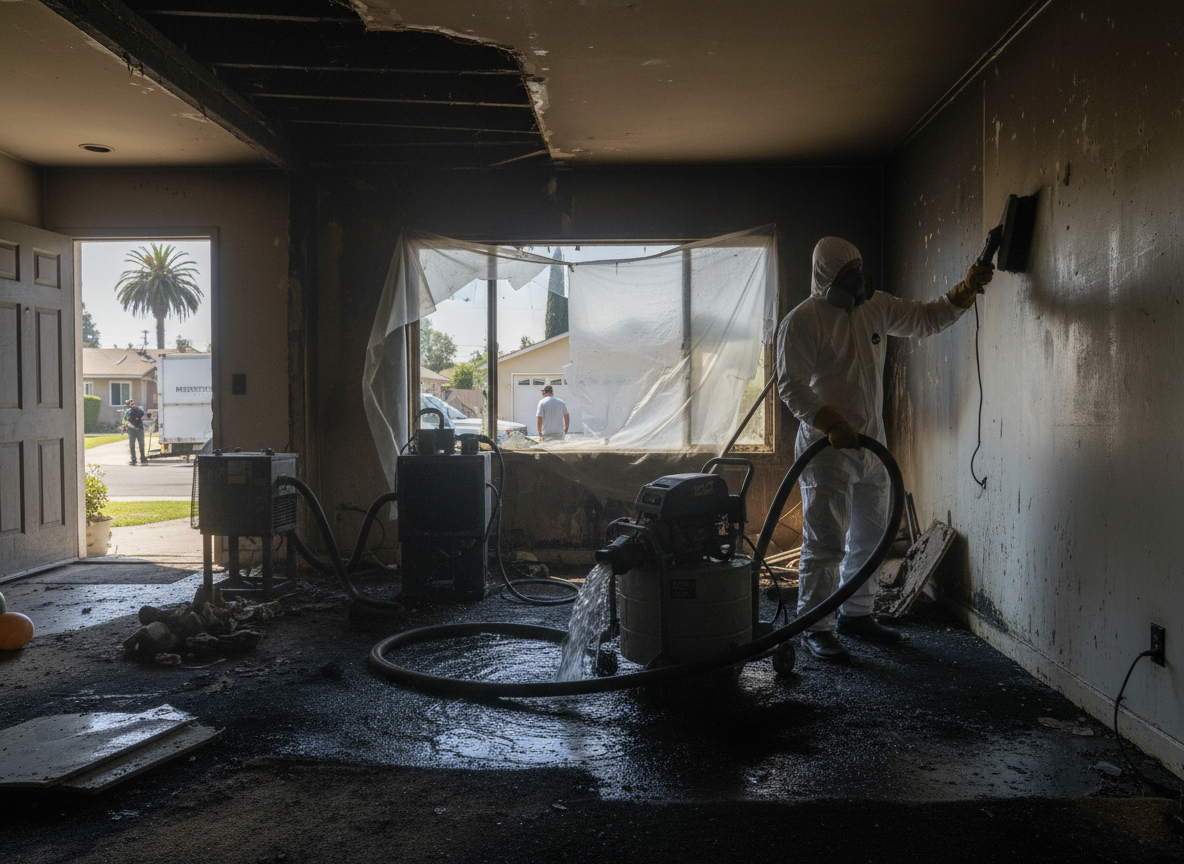
Lake Balboa home after structure fire
Fire broke out in a single-story home two blocks from Lake Balboa Park. Hose lines saturated the living-room slab and attic. We mapped moisture through the slab, removed wet insulation, ran drying equipment for six days, then replaced the affected drywall and flooring. The owners moved back in without further mold issues.
How it works
- 1
On-site assessment
Technician inspects fire and water damage at the Van Nuys property, records moisture levels and identifies affected materials.
- 2
Water removal and containment
Standing water is extracted and containment barriers are placed to limit smoke and moisture spread into unaffected areas.
- 3
Drying and monitoring
Industrial air movers and dehumidifiers run while daily moisture readings track progress until levels return to normal.
- 4
Cleaning and odor removal
Soot is removed from surfaces, HVAC systems are cleaned and thermal fogging neutralizes smoke odors.
- 5
Restoration and repairs
Damaged drywall, flooring and insulation are replaced and final walkthrough confirms the home is ready for occupancy.
Pricing
Upfront quotes provided after on-site inspection; no two jobs are priced the same because damage extent and access vary by property.